Lord, where to even begin here? I’ve been actively dreading this review since I saw Inglorious Basterds a little while ago. Tarantino films are complicated enough to watch. The concept of giving an academic opinion on such a tricky film as this made me quake in my boots moments after leaving the cinema.
A second viewing recently quelled some of my fears. First-off, this is definitely a film you need to see more than once. I mean, sure, I loved it the first time round. Like, really loved it. But the second viewing, after I was free to research and dig without having to hide from spoilers, it just intensified and amplified the whole experience for me. I noticed the subtle nuances in the acting regarding the characters and where they were at that specific moment. Inglorious Basterds need to be seen, digested and seen again for full understanding and context. It was just made that way.
The premise of Inglorious Basterds, if you’ve not seen the trailer, appears to be this: 10 or so Jewish-American soldiers are dropped into a Nazi-occupied France during the closing stages of World War II. There, they pretty much wreak havoc on every Nazi soldier they find in a variety of gruesome and merciless ways (and the ones they do show mercy to are horrendously compensated for this). They decide disposing of the enemies in these outlandish and cruel ways isn’t quite awesome enough, so they decide to blow up a cinema on Nazi-night, thus ending the war.
Sounds pretty straightforward and cool, right? Ever seen a Tarantino film before? The trailer accounts for 2 of the 5 chapters of Inglorious Basterds. About halfway through this 152 minute-long epic, we realise that it’s not the Basterds who are really the main characters at all. The focus of the film shifts repeatedly between them and Shoshanna, who’s story is far too wonderful to give away.
Some would argue the pace is slow, where as I instead feel that the film lingers upon it’s own dialogue and characters, not wanting to spoil its own world by moving too quickly by them. The first chapter is a 20-minute conversation between two people sitting at a table. That’s it. The film maintains that perfect balance of making us relish the extended dialogue sequences, whilst cheering when these parts are interrupted by some good-old-fashioned Quentin-patented mayhem.
It certainly is a film that defies genre. While the action is important, it is not prominent. The drama is diluted by a lot of well-timed and well-placed black comedy and the magnitude of the war itself is only really touched upon in the final act. The best thing about all that is that each of these contradictions blend in with, and even complement each other to the point where what we’re viewing looks less like a jumbled mismatch of over-ambitious ideas and more a multi-layered, perfectly planned miracle.
Acting-wise, it’s no surprise Christoph Waltz was named Best Actor at Cannes. It’s a part that quite literally has to be seen to be believed. Keep an eye out. Elsewhere, Pitt impresses with a predominantly comedic turn as Aldo Raine, leader of the Basterds. Pitt’s at his best in the second chapter as he interrogates a Nazi Officer on the whereabouts of another squad in the area. On his refusal, he send out Eli Roth’s Donny Donowitz, a huge, angry Jew with a baseball bat. Awesome.
It’s actually Roth who impressed me more than most in Inglorious Basterds. The scene where he delivers some almighty punishment using his weapon of choice is preceded by Donowitz inspecting the officer’s badge and asking “you get that for killing Jews?”. It’s a perfect question, injected with so much controlled anger and sadness that it makes for one of the most powerful moments in the film. Despite Chapter 2’s more fun-loving tone, it’s certainly one of the more affecting moments in the entire thing.
Tarantino here has not only exceeded expectations, but exceeded them to such a degree one wonders if Inglorious Basterds could ever truly be topped as his best film. The film’s final line echoes this. And, to be honest, if this is the best we ever see of him, it’s a more than fitting case for his genius overall.
*****
share on:
facebook
Monday, 24 August 2009
Review: Inglorious Basterds


Sunday, 9 August 2009
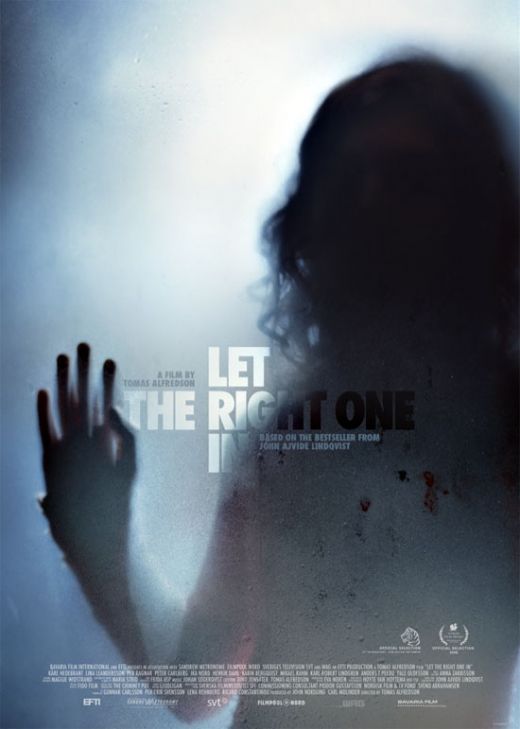
Review: Let The Right One In
Alright guys. Before we start, elephant in the room. You may or may not know Let The Right One In is a romance/vampire film, and you WILL know that, last year, a very popular and very high-profile romance/vampire film was released. It was almost impossible for me, as I watched Let The Right One In to not compare it to Twilight in my critical consideration. The concepts are undeniably similar, and I believe it's this coupled with the fact Let The Right One In is Swedish that caused the film to go largely unnoticed in a mainstream audience.
Let The Right One In opens in a small Swedish town. It is 1982 and Oskar finds himself bullied daily. He spends his nights planning and practicing violent revenge against his attackers. One night, while out stabbing trees, he meets Eli. Who's a vampire, just so you know.
What follows is a bleak, heartbreaking, solid, beautiful and real story of the two. It's gripping and intensely frightening, even without the horror subplot. Most of the credit here has to go to the two young actors who play Oskar and Eli (Kåre Hedebrant and Lina Leandersson) who give performances that actors 6 times their age would be commended for.
The film itself is written to perfection. Subtle indications of a character's fate/nature are alluded to and then never mentioned again, leaving it to you to piece together some of the facts. The dialogue is affecting and low-key, in keeping with the colour palette and soundtrack. This is not a horror that relies on CGI or jump-out-of-your-seat moments which, given some of the scenes, it very well could have been. When CGI is finally used in an obvious sense, it doesn't quite work and transports you out of the film for a short while, before quickly rediscovering its pace.
By far the best thing about Let The Right One In is the seamless integration of a real horror story with a real love story. While it isn't a blend by any means, both are represented side-by-side and complement each other until the very end. One minute you find yourself reeling at one of the very graphic horror scenes (one guy gets half his face burned off at one point. It's mental. Worse than Harvey Dent in The Dark Knight) and the next moment Eli and Oskar are standing on either side of a window, following each others handprints while I sit, 8 inches from the screen in hysterical tears shouting "LOVE EXISTS AND IT'S BEAUTIFUL".
Inevitably, things start to go tits-up for everyone and, as the film concludes we are treated to one of the best scenes in film of the last, well... ever. It's shocking, disturbing and just a little pleasing. The film ends on a high, but deliberately leaves a bloody trail behind it. Come the finale, morality grips and we find ourselves wondering if the bloodshed was worth it for the freedom of our protagonists.
Watch it, I beg you. Forget the subtitles and just get lost in the story. It's so worth it.
*****
share on:
facebook
Friday, 7 August 2009
The 5 Best John Hughes films.
I miss him already. Despite the fact he pretty much became a recluse in '94, it was a comfort to know he was still out there. It's still very affecting for me, I've been singing his praises ever since I got into the whole film game. But everything must end.
Chances are, if you ever saw a comedy film in or from the 80's, Hughes was involved somewhere along the line. The impact he had back then, the ripples of which we are still experiencing today, is astronomical. So here it is, my way of a sendoff. Hughes' finest five. In my opinion, of course.
5. Home Alone
The film that inspired thousands of at-home accidents. Hughes is here, and always has been proof that a high-concept idea doesn't necessarily doom it to conforming to broad and jarring humour.
4. The Breakfast Club
One of Hughes' famous and most-loved. Stunningly heartfelt and funny without sacrificing too much social realism and relevance. Like most of his films, this is an unparalleled feelgood film.
3. Uncle Buck
Hughes' long-time friend and cinematic legend John Candy steals not only the show here but pretty much everything to go along with it. Stunningly warm with a neat edge and some subtle commentary on the changes youth culture has seen since Hughes grew up. A joy.
2. Ferris Bueller's Day Off
Ridiculous, unbelievable and over-the-top. And brilliant. Another defining teen film from Hughes. Matthew Broderick enjoys himself in and out of character, here. Bringing a charm and flare to this already so-enjoyable-it-should-be-banned piece.
1. Planes, Trains and Automobiles
What to say? A masterpiece. The film that showed the world Steve Martin and John Candy CAN act. More tonal and emotional shifts than any other Hughes films helps this become an all-inclusive classic. The ultimate buddy movie sees Martin's uptight and neurotic businessman Neal Page pair up with Candy's warm but irritating Del Griffiths in a bid to get home for thanksgiving. Needless to say, bad luck ensues.
With a shocking and heartbreaking twist at the end, Planes, Trains and Automobiles establishes itself as Hughes' best and most charming film ever.
One last time, goodbye, John. We won't forget about you.
share on:
facebook
John Hughes.
Reblogged from my website:
I know I’ve been posting a lot in the 2 days I’ve been here, but the news has just reached me that today, John Hughes, director of one of my favourite films of all time (Planes, Trains and Automobiles) passed away at the age of 59.
Hughes was an incredible filmmaker and his work today remains regarded as some of the funniest, most heartfelt and most influential stuff to have ever been seen in cinema. An extraordinary talent, he will be sorely missed.
share on: facebook
Monday, 3 August 2009
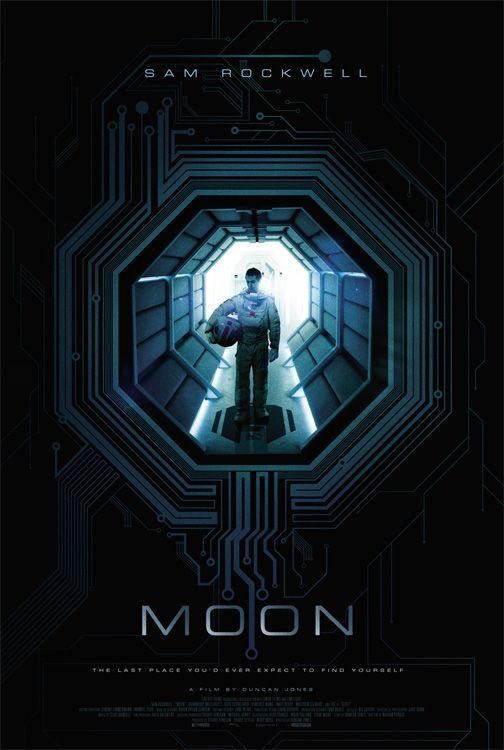
Review: Moon
As most of you die-hard fans will know, I wasn't a huge fan of JJ Abram's latest try at directing in Star Trek. It was good and everything, but the pretentious film-lover in me has been very vocal this summer, prompting me to dust off some of the films that may be considered very limited in their nourishment of the intellect. Star Trek was 80% bang and 20% other stuff. I guess sci-fi just lends itself to that kind of thing. I mean, space adventures are pretty unbelievable to begin with so it's pretty easy to lure an audience with any kind of plot you can care to think up. Star Trek, Transformers, these are the films to which Moon provided a timely antidote. A brainteasing, minimalist and character-driven space story with more depth and intrigue than any overlong robot/alien "epic".
Moon opens, unsurprisingly, on the Moon. In the not-too-distant future Sam Bell (Sam Rockwell) sits alone on the far side of Earth's iconic satellite in a station, collecting energy and sending it to earth via little rocket things. He's been there for nearly 3 years and in 2 weeks, he goes home to his wife and baby daughter. All seems to be going well with Sam, although even at the beginning there's an underlying feeling of menace and foreboding as we witness him talking to himself and advising his bosses through a recorded message that 3 years is far too long for any man to remain in solitude. He's not COMPLETELY alone, though. He is assisted in everyday routines by Gerty (Kevin Spacey). Gerty is an intelligent but low-tech (by normal sci-fi standards) robot that moves about the station and talks to Sam, keeping him company. It's a relationship that builds throughout the film rather than deteriorate, a route so many man-and-machine stories go down eventually. Anyway, yes, everything seems to be going relatively well with Sam until certain events begin to occur. Nothing major, just a small indication that maybe he has been up on the Moon for too long. The event occurs again while he's performing a routine check in a buggy, causing him to crash, which is when things really get interesting.
Sam awakes in the base's infirmary. This here is a mystery in itself. In an uninhabited environment apart from himself, how did he get back to the base? Gerty is on hand to comfort Sam after his crash (remember his words in this part) and the routine begins again. That is, until Sam begins to get ever-so-slightly suspicious and decides to go back to the crash site. There, the film takes the most important twist in its modest 100-minute running time as Sam discovers Sam, still unconscious in the crashed Buggy.
To continue with any kind of synopsis would be cruel and detrimental to the impact the film has. What ensues is a thought-provoking, emotion-evoking and above all EXCITING drama about the human condition and morality. The best thing about Moon is arguably Rockwell himself, who channels both the main characters as very different personalities, despite the fact they are the same person. The interaction between the two of them is not only a testament to Rockwell's acting ability which really does excel here, but also the special effects that allow them to interact so seamlessly. All the more impressive when you consider Moon's small budget.
As the plot thickens and a small race-against-the-clock element is introduced, one would expect a third act lull in quality and intrigue as most films like this tend to fall for, replacing the heart and soul that originally transfixed us with a lot of running and shooting. Magically, Moon keeps its own pace and the finale unfolds on its own terms, offering not only an extremely satisfying conclusion but an overwhelming sense of reward on the audience's behalf.
In a Summer bloated with money and gloss, it's a relief to find such an elegant and beautiful film in Moon to enjoy. With an consistent, engaging story and some mighty fine acting, I might be inclined to say it's the best film of 2009 so far. Maybe.
*****
share on:
facebook
Thursday, 30 July 2009
The review of Summer
Summer is an interesting time of year. For some people. For others, like me it’s an excuse to avoid the sun at almost any cost. So here, as a welcome back present, it’s my review of some of the films I’ve watched (and re-watched) in my many venues for holiday fun these past few weeks.
My travels first took me to Greece, where I watched Superbad about 4 times alternating between having the commentary on and off.
Rating: ****
I also watched the DVD extras which gave me something new to laugh about. That 2-disc edition is literally essential for a Superbad fan.
Rating: *****
I also bit the bullet and finally saw Children Of Men, which I’ve been told by everyone ever is a fantastic film. Note to people: yeah, you’re right.
Rating: ****
Ron Howard’s classic Parenthood is a very under-appreciated film despite the amazing cast. Steve Martin’s best role? Go on, then.
Rating: *****
In Bruges got its fair share of plays in all locations. It remains at ***** and retains its #1 spot on my all-time favourites list.
Next up was Devon where the screwball comedy fan in me got to express himself in all his glory. My week in DVD here consisted of:
Airplane!, perhaps the first and best modern screwball. I have nothing more to say on this fantastic film except GO SEE IT
Rating: ****
Liar Liar, another fine choice for the comedy fan. If you haven’t seen it, find out the nearest institution to admit yourself to.
Rating: *****
Harvey. My dad’s favourite film. Get past the age of the film (59 years old) and enjoy one of the finest pieces of American cinema ever. Better than It’s a Wonderful Life.
Rating: *****
As well as all this, I also ended up watching Come Dine With Me on a near-daily basis. To this day, I still am.
The final leg of my travels took me close to home, but still away from home nonetheless. Here, I experienced (and made others experience) yet more of Woody Allen’s genius in two of his greatest achievements to date: Vicky Cristina Barcelona (*****) and Everyone Says I Love You (**** - stay tuned for a bigger piece on this one)
I also dipped my toes into the tranquil pastures of some fucking gory horror stuff in the form of 28 Days Later (*****) and Repo! The Genetic Opera (***)
I managed to see a film that’s been haunting me for years yet always remained elusive in The 40 Year-Old Virgin, it really is funny.
Rating: ****
Rewatching Thank You For Smoking and Watchmen in the past few days gave me a freshened yet similar view on them both, too: They’re fucking amazing
Rating for both: ****
In cinema, I managed to see Harry Potter 6 which, as any self-respecting human being with half a brain will tell you, is OK.
Rating: ***
That’s all for now, Next stop, Moon.
Not literally.
share on:
facebook
Wednesday, 1 July 2009
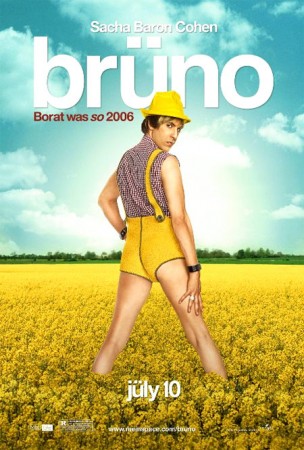
Review: Bruno
Ever since Borat in 2006, we were left wondering: what’s next? Sacha Baron-Cohen has a good thing going, if you can understand and appreciate his style of humour/filmmaking then he never fails to deliver. The downside to his approach is we’re only ever going to see each of his characters for a short while before he has to get rid of him, lest the fame of his previous endeavors ruin his attempts to stay below-the-radar enough to expose most people as the monsters they are, which is essentially what he enjoys doing most.
Bruno, of course, was next. Now, Baron-Cohen’s characters have had a film each. Ali G In Da House was a scripted comedy while Borat was an overseas mockumentary, a veritable barrage of clips of him embarrassing the American people in a series of stunts. Bruno very much copies the latter, almost too much in some cases. In both films, about two-thirds of the way in we see the title character broke, abandoned my his travelling partner and struggling to make an impact. Bruno does indeed repeat many beats of Borat, but that’s not to say it’s necessarily a bad thing. Where Borat was loud and clueless there is a deeper sensitivity to Bruno, one that almost shines through as genuine before we hastily remind ourselves this guy is about to cause a riot/security threat/shutdown of the production of a Prime Time TV Drama.
ALthough Bruno may be EVER so slightly flatter than Borat, it makes up for its decreased laugh-out-loud moments with some truly shocking and horrific scenes, an instance of which involves Bruno screening a pilot of his show for a focus group, the climax of which is bruno dancing COMPLETELY naked before the camera zooms in and his urethra, yes, HIS URETHRA opens up like a mouth and says “Bruno”. It’s clear that Baron-Cohen is still as cruelly calculated in his torture of the innocent and unaware as ever and it still works. The formula manages to stave off tedium with his unearthly knack of getting people to reveal much darker sides to themselves than they would ever admit to. These include getting a mother to agree to make her 6-year-old daughter lose ten pounds in a week for a photoshoot, getting a TV celebrity to say Jamie-Lynn Spears should abort her “retarded” baby and getting Paula Abdul to speak about Human rights as she sits on the back of a Mexican worker due to a lack of furniture.
Believe me, I’ve spoiled nothing. There’s more shocks crammed into this films measly 89-minute running time than any film I’d care to mention and surprises will be plentiful, no matter how many times you’ve seen the trailer. The content of this film warrants an immediate second viewing because there’s just so much being thrown at you to fully absorb before you’re plunged into the cold, unfamiliar depths of another Baron-Cohen stunt.
I urge anyone who may find offense in sexism, racism, homophobia or xenophobia to definitely see this film. I enjoy nothing more than your bitter revenge in some strongly-worded rant on a public forum, and Sacha Baron-Cohen loves it, too. This film is designed to keep people talking and that’s exactly what people do. So why fight it? Accept it’s 3-0 to this wind-up God and be on your way.
To summarise this beautifully crafted, flowing piece of literature that only 1.30am can produce, Bruno is very, very good. Borat one-ups it on laughs alone but Bruno trounces in all other areas. Less annoying catchphrases, too. But who can resist: “Vassup?!”
****
share on:
facebook